Offset Smoker Guide: How the Firebox and Chamber Work
An offset smoker is a charcoal- or wood-fired cooker with a separate firebox mounted to the side of the cooking chamber, so heat and smoke cross the chamber and food cooks by indirect heat. Here is how the parts work and what importers review.
How an Offset Smoker Cooks
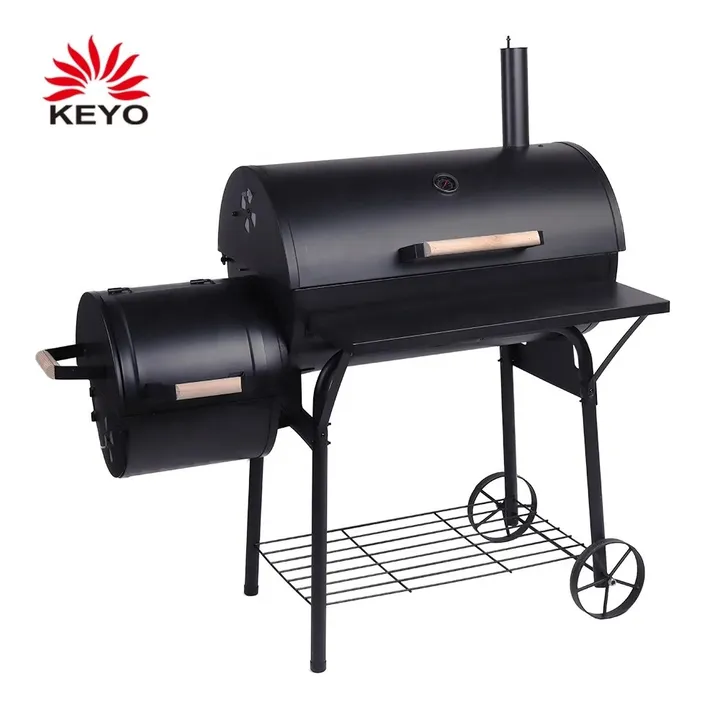
An offset smoker is a charcoal- or wood-fired cooker built around a cooking chamber and a separate firebox mounted to its side. The firebox holds the burning fuel, and heat and smoke pass through an opening into the chamber, cross the cooking grates and leave by the chimney at the far end. Because the food sits away from the coals, it cooks by indirect heat rather than directly over the fire. The main parts are the firebox, the chamber, the chimney and the cooking grates, carried on a cart, legs or frame.
Control comes from the air intake on the firebox and the damper on the chimney. The balance between the two sets how the fuel burns and how smoke moves across the chamber, which is why the firebox opening, baffle and chimney position are the parts buyers examine first in a sample. Dimensions, grate area, plate thickness and weight vary by model and sit in the specification table and the quotation.
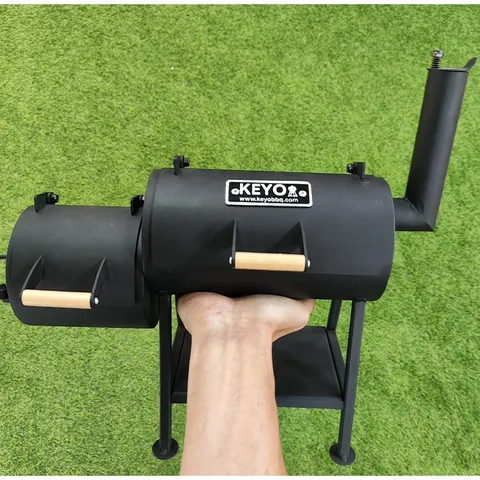
Hand holds miniature offset smoker over grass 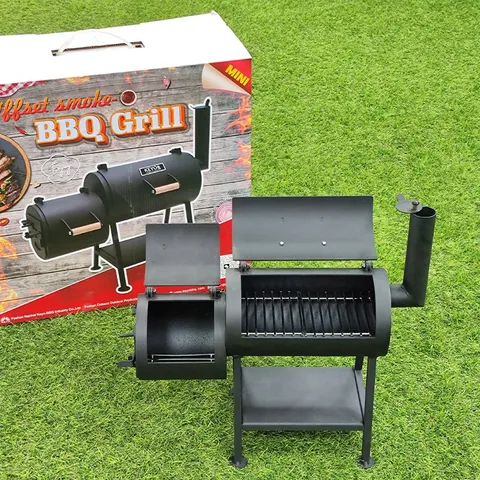
Open miniature offset smoker beside retail box
Offset Smoker Names Explained
An offset smoker grill is the same side-firebox format under a name that highlights grilling. The name describes how the unit is used, not a separate product.
Offset BBQ smoker, offset smoker grill and offset grill are market naming variants for the same side-firebox layout. The wording shifts by region and by retailer category, where a catalogue may lead with the cooking method, the fuel or the shape of the unit. The name does not change the format, so category managers can align titles and filters around the same product concept and keep fuel advice, images and spare-part references consistent across the line.
Model questions such as chamber depth, grate configuration or cart fittings are settled in the specification table and the quotation, not in the naming.
Horizontal and Vertical Offset Smoker Formats
A horizontal offset smoker runs the chamber lengthways beside or above the firebox, giving a long grate area and a gradual path for smoke. A vertical offset smoker stacks the chamber as a cabinet beside the firebox, with cooking levels set above each other and a compact footprint for the grate area it offers.
Keyo’s charcoal range includes a vertical offset charcoal smoker supplied with wheels and a thermometer. Which format fits a range depends on the plan: horizontal units suit shoppers after a wide grate and a familiar barrel profile, while vertical cabinets suit tighter floor space and cooking across stacked levels. Footprint, rack count and load details are confirmed in the specification table and the quotation.
Grilling Zone and Smoking Zone
A charcoal grill with offset smoker uses the main charcoal chamber as a grill and the side firebox to feed smoke into the chamber for indirect cooking, so the same cooker covers grilling and smoking. Coals sit in the main chamber for direct grilling; with the fire moved to the side box, the chamber becomes an indirect smoking space and the grates hold food away from the fuel.
For a range plan that means a buyer can answer grill demand and smoking demand without carrying separate products, and a retailer can present the unit under either heading. Keyo’s charcoal range includes an offset smoker with a chimney and a vertical offset charcoal smoker, which show the format in horizontal and vertical shapes. The charcoal grills range covers the neighbouring formats.
Fuel: Charcoal and Wood
An offset charcoal smoker runs on a charcoal bed as its main heat source, with wood chunks or splits added for smoke character. Charcoal gives a steady base fire; wood changes the aroma of the smoke. How much wood a cook adds, and in what form, is a matter of preference and differs by market, where some expect logs and others chunks or chips.
Keyo’s smokers range covers the offset charcoal smoker alongside other charcoal formats.
What Importers Check When Sourcing Offset Smokers
When an importer asks for a heavy duty offset smoker, the sample and the specification sheet are read for construction rather than for a label. Reviewers look at steel gauge, welded seams, door and hinge fit, how the lid seats on the chamber, cart or leg construction, work surfaces and finish. Those points show how the unit is put together and how it will display in a store; they are not a durability rating. Plate thickness, weight and coating data sit in the specification table and the quotation.
- Steel gauge on the chamber, firebox and door
- Welded seams where the firebox meets the chamber
- Door and hinge fit, plus the seat of the lid
- Cart, leg or wheel construction and how it is fixed
- Work surface, shelf fixing and finish
Keyo’s quality checks include metal plate thickness, coating thickness, cross-cut coating adhesion, product weight and product measurement tests. These describe the checks the factory runs rather than a guarantee for any model, and the acceptance criteria for an order are set during sampling and quotation.
Custom Offset Smoker Projects
Keyo offers OEM service, design service and buyer labels.
MOQ depends on the product model, customisation requirements, packaging method and order plan; for OEM/ODM projects it is confirmed from the material, structure, tooling and packaging requirements. A brief should set out the chamber and firebox configuration, the branding method and the carton or pallet format. The manufacturing page covers the flow from plate to packed unit.
Samples, Lead Times and Capacity
Keyo’s quotation gives about 3 days to dispatch stock items and about 7 days for custom samples. Bulk orders are estimated at about 30-40 days after payment, and the lead time for each order is confirmed in the quotation. Payment methods include T/T, L/C, PayPal, Western Union, MoneyGram and credit card, delivery terms include FOB, CFR, CIF, EXW and DDP, and the nearest ports are Yantian, Huangpu and Beilungang.
Keyo was established in 2015, and its factory covers 30,000-50,000 square meters in Nanhai District, Foshan, Guangdong Province, with 201-300 people, 8 production lines and daily output of up to 20,000 pcs. The range covers more than 2,000 models with more than 20 new products a year, and 99% of products are exported. The largest markets are Southern Europe and Northern Europe at 17% each, Central America and North America at 9% each, the domestic market at 8% and Western Europe at 7%.
The contact page opens an inquiry.
Request a quotation
Describe the products, quantities and market you are sourcing for, and Keyo will reply with matching models and a quotation.
Or write to sales@customcharcoalgrill.com